
Construction Accreditation

CLOCS-A Construction Accreditation is a mark of excellence, demonstrating your organisation’s commitment to safety, efficiency, and community well-being in construction logistics. By adhering to CLOCS-A’s rigorous standards, accredited organisations prioritise the safety of vulnerable road users and ensure responsible vehicle movements in high-impact construction areas.
Who Needs CLOCS-A?
CLOCS-A applies to development projects that significantly impact local communities, including:
- Large-scale infrastructure developments with prolonged construction timelines
- Projects in areas where construction traffic movements need to be carefully managed (e.g., busy residential neighborhoods)
- Developments located in areas with a high volume of vulnerable road users or a strong presence of cycling and walking activities
- Projects near intersections where accidents involving construction vehicles and vulnerable road users have been reported
- Any development or planned road maintenance that involves frequent movements of construction traffic.
Why Get Accredited?
- Demonstrates leadership in safety and compliance
- Optimises logistics while reducing road trauma
- Enhances sustainability through smarter traffic management
- Builds trust with communities and stakeholders
Take the Lead in Construction Safety
Whether you are a Developer or a Principal Contractor, pursuing CLOCS-A accreditation offers the opportunity to guarantee safe and efficient construction practices.
Explore the requirements for Developers and Principal Contractors:

Developers

Principal Contractors
Developers
As a developer or construction company, you play a crucial role in ensuring the safety of the community impacted by your operations. CLOCS-A offers a comprehensive framework to mitigate risks associated with construction vehicle activity, protecting vulnerable road users (VRUs) and enhancing road safety standards.
By adopting the CLOCS-A Standard and implementing Construction Logistics Management Plans (CLMP) and Construction Traffic Management Plans (CTMP), your organisation can:
- Prioritise safety across the supply chain
- Ensure compliance with industry best practices
- Reduce vehicle-related impacts on surrounding communities
- Minimise disruption from site logistics, including goods, waste, and equipment movements
- Protect your reputation and investment
As a major procurer of goods and services for maintenance and construction projects, you have the power to influence the behaviour of the entire supply chain. The CLOCS-A Guide, ‘Incorporating CLOCS-A in client procurement,’ outlines the key steps that public and private sector clients should take to include CLOCS-A in their procurement strategy.
What does the Standard require of Construction Project Developers?
Developers and clients must:
- Specify in the tender and contract documents that all stakeholders must comply with the CLOCS-A Standard.
- Ensure that the project team develops and implements a suitable and sufficient CLMP (Construction Logistics Management Plan).
- Ensure effective monitoring of compliance with the CLOCS-A Standard.
- Obtain and monitor the contractor’s action plan to address all identified issues and non-compliances.
- Ensure that all collisions that result in harm (and near-miss incidents) that occur on journeys associated with the project are quickly investigated, and corrective actions taken to prevent recurrence.
Principal Contractors
As the key figure responsible for managing site construction, operations, and the procurement of supplies and services involving vehicle deliveries, principal contractors play a vital role in ensuring health and safety both on-site and within the surrounding community. The CLOCS-A Standard provides a consistent, national framework to help principal contractors minimise risks associated with construction vehicles and drivers.
By adopting CLOCS-A, principal contractors can strengthen safety standards across their supply chains. CLOCS-A offers practical tools and guidance to support on-site implementation, including:
- Construction Logistics Plans (CLPs): Cost-effective strategies to manage expenses and ensure project timelines.
- Contract Integration: Enabling procurement processes that require suppliers to meet CLOCS-A compliance standards.
- Site Condition Classifications: Assisting in selecting appropriate vehicles for specific tasks.
- Site Monitoring Checklist: Reinforcing safety and compliance requirements consistently.
- Gate Checks: Ensuring fleet compliance and maintaining high safety standards.
- Site Monitoring Visits: Supporting continuous improvement through regular compliance assessments.
What are the Responsibilities of a Principal Contractor according to the CLOCS-A Standard?
Principal contractors are expected to:
- Conduct Risk Assessments: Identify potential risks to the community associated with project activities.
- Develop and Maintain a CLMP: Ensure the Construction Logistics Management Plan (CLMP) is both suitable and comprehensive.
- Procure Responsibly: Ensure site and fleet operations fully comply with the CLOCS-A Standard.
- Promote Safe Site Operations: Implement safe routing, level access/egress, stable loading/unloading zones, effective delivery management systems, and qualified site traffic marshals.
- Perform Gate Checks: Assess heavy vehicles (HVs) and drivers for CLOCS-A compliance, promptly addressing any non-compliances through risk mitigation and procurement actions.
- Monitor Compliance: Independently review CLOCS-A compliance at least every six months and take corrective action as needed.
- Incident Investigation: Review all incidents involving harm (or near misses), conduct prompt investigations, and implement measures to prevent recurrence.
Become a CLOCS-A Member
A CLOCS-A Member is committed to:
- Having at least 20% of its sites/fleet formally reviewed by the CLOCS-A team.
- Having a clear plan to get the majority of its sites to be CLOCS-A compliant within two years.
- Having a clear plan to encourage other organisations to adopt the CLOCS-A Standard.
Implementing CLOCS-A
CLOCS-A Accredited Organisations are party to a Memorandum of Understanding with CLOCS-A. An implementation plan provides a headline statement of corporate intent to implement and comply with the CLOCS-A Standard.
You will require headline figures to indicate the overall scale of your operations, including the approximate number and location of sites you have across Australia where construction vehicles regularly visit and could implement the national CLOCS-A Standard.
Ready to Get Started?
Pursue CLOCS-A Accreditation today to showcase your commitment to safety, reduce operational risks, and set the benchmark for excellence in construction logistics.
Accreditation Resources
Prepare for Application
Accreditation Training Course
Guidelines on How to Apply for CLOCS-A Accreditation
Prepare for Audit
CLOCS-A Documents
Self-assessment Checklist
Route Assessment Tool
Vulnerable Road User Training
Construction Accreditation



Infographic CLOCS-A Accreditation Process
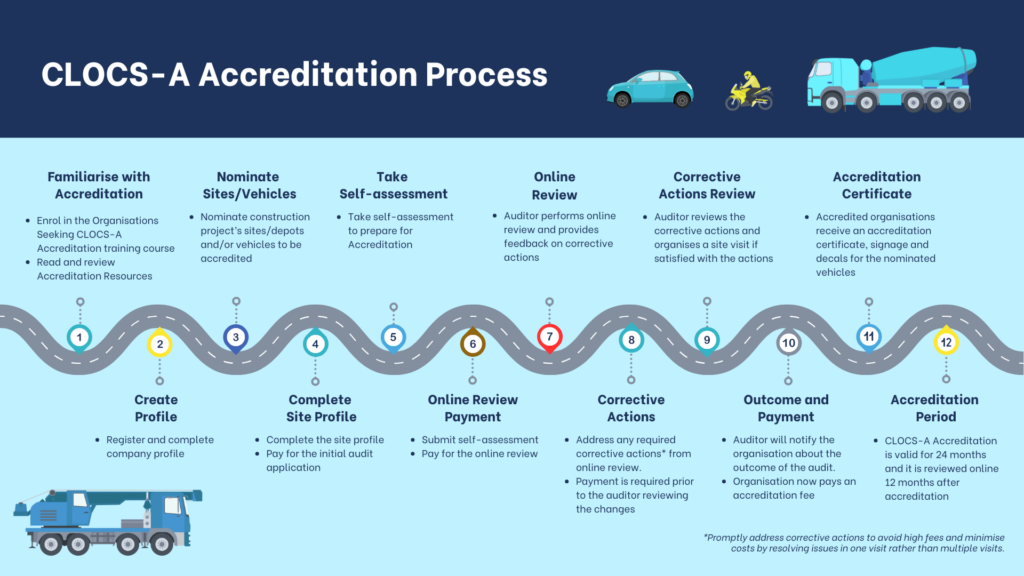
Click image to expand or download infographic here.