Working With CLOCS-A
-
Australia and the United Kingdom (UK) are different?
CLOCS-A will be adapting UK’s CLOCS to Australia. The CLOCS-A Steering Group has already developed a paper identifying the key differences between Australia and the UK which each of the Technical Groups will be drawing on. The power of CLOCS-A is the ability to mandate elements through the standard that is specific to this industry sector which may be regulated in the UK such as side under-run. Whilst there are differences between countries, we experience very similar challenges with construction transport activities required to operate in urban environments, and on local roads to service construction sites. In addition, there are no equivalent schemes, standards or codes of practice which have been developed specific to managing the on-road hazards and risks encountered in the construction transport sector.
-
How is CLOCS-A led?
The development of the CLOCS-A standard is led by a diverse Steering Group formalised through a Memorandum of Understanding consisting of researchers, major projects and government transport departments.
-
What is the CLOCS-A Memorandum of Understanding (MoU)?
A CLOCS-A Memorandum of Understanding, established in 2021, is bringing together industry, researchers, major projects and government transport departments, and can provide the collaborative governance basis to develop and establish CLOCS-A. The MoU is currently housed on the NRSPP who is currently leading the development of the program.
-
Who are the CLOCS-A MoU SG Partners?
The CLOCS-A MoU is currently led by the National Road Safety Partnership Program in collaboration with Amy Gillett Foundation, ARTSA Institute (ARTSA-i), Australian Trucking Association, Major Transport Infrastructure Authority, Monash University Accident Research Centre, Transport for NSW, Sydney Metro, Transport for London, Truck Industry Council and Victorian Department of Transport.
What is CLOCS-A?
-
CLOCS-A is currently in its development stage, what is the end game?
The final stage in the development of CLOCS-A includes an expression of interest stage to identify the best organisation to host the standard. CLOCS-A like NRSPP and Safe Load Program is hosted by an organisation with aligned interests and values. The development of CLOCS-A will include creating a sustainable model and then a home for it.
-
How do you partner with CLOCS-A?
Any organisation can be part of CLOCS-A. Its establishment is centred around collaboration and to be a part of its development all you have to do is join the MoU as a Supporting Partner. What this entails is a letter of commitment which the Steering Group will review and endorse. There is no cost.
-
Is there a local example where the foundations of CLOCS-A has been applied?
Australia’s two largest public transport infrastructure builds, Sydney and Melbourne Metro, have both adapted portions of UK’s CLOCS standard into their contracts. They did this because it is recognised as world’s best practice. They knew it would protect the community, workers and truck drivers during the build and thus reduce the risk of the project contributing to a fatality.
-
What are the timelines for CLOCS-A?
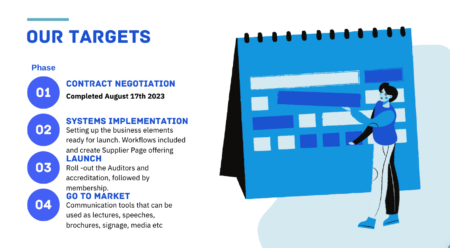
We are well into our systems implementation and we have broken these into phases. The four phases are described below:

Our journey has been plotted in a timeline as follows:

-
What is CLOCS-A?
Construction Logistics and Community Safety – Australia (CLOCS-A) is a national construction logistics safety program designed to revolutionise the management of work-related road risk in the construction sector. CLOCS-A provides:
• Comprehensive road safety, risk and business management for heavy vehicle related logistics of construction projects.
• Consistent single standard and process providing peace of mind for all users within the supply chain.
• Bridge builder between trucks and Vulnerable Road Users (VRU), cyclists, pedestrians and motor bike riders. -
What is the evidence that CLOCS works?
Independent evaluation of CLOCS in the UK found that the introduction of the program resulted in:
37% fewer complaints when implementing CLOCS
47% reduction in fatal and serious injury crashes between heavy vehicles and vulnerable road users when implementing CLOCS
25% reduction in total collisions
76% less likely to commit licensing offencesThe Standards developed by CLOCS-A are underpinned by evidence and guided by the Safe System Approach to Road Safety.
-
What is the origins of CLOCS-A?
CLOCS-A is inspired by the success of the CLOCS Program established in the UK to tackle the emergence of similar risks following an unprecedented construction boom in metropolitan areas whilst being more nuanced to local issues in Australia. Today, the CLOCS Program remains as the UK’s only safety standard for construction logistics consolidating multiple standards, schemes and policies into one work-related road safety standard and is widely recognised as the world’s best practice in protection for VRUs. In Australia our largest public transport infrastructure have based their logistics safety standard off CLOCS.
-
What is the relationship with Transport for London (TfL)?
Since 2016 NRSPP has been building a collaborative relationship with Transport for London with regards to adapting their CLOCS program to Australia. Following two webinars relating to CLOCS and its development NRSPP with Melbourne Metro signed an MoU with TfL regarding the adaption of CLOCS to Australia. NRSPP has continued to build the relationship resulting in the broader 2021 MoU being signed.
-
Why should CLOCS-A be introduced?
Australia is undergoing an unprecedented $200 billion major infrastructure build in our cities for at least a decade. And key to its success is trucks, without them none of these can be delivered. This means more trucks on our roads and increased risk of interactions between them and cyclists, pedestrians and motor bike riders. People make mistakes when on the roads and when it involves a truck it is often fatal. CLOCS-A is about reducing the impact of these mistakes such that all road uses are more aware and understanding and tolerant of each other on the road.

Can Suppliers and Partners integrate with the CLOCS-A Accreditation system?
-
Can Suppliers and Partners be integrated with the CLOCS‑A Accreditation System?
No. Suppliers and Partners cannot be integrated into the CLOCS‑A accreditation system.
CLOCS‑A accreditation is strictly limited to organisations that directly operate, manage, or control transport activities that impact road safety and vulnerable road users. This includes construction clients, principal contractors, transport operators, and plant hire companies under the Plant Hire–Led Model.
Suppliers and Partners—such as technology vendors, equipment providers, consultants, training organisations, or service partners—do not perform transport activities and therefore cannot be accredited.
Why they are not eligible
- CLOCS‑A accreditation assesses operational safety performance, not products or services.
- Suppliers and Partners do not operate vehicles, drivers, or logistics activities, so they cannot meet the mandatory evidence requirements.
- Allowing non‑operational entities would undermine the integrity and comparability of the accreditation scheme.
What Suppliers and Partners can do
While they cannot be accredited, they may:
- Support accredited organisations with compliant products, systems, or services
- Promote alignment with CLOCS‑A requirements
- Participate in industry events, working groups, and knowledge‑sharing activities
They simply cannot be listed, recognised, or displayed as CLOCS‑A accredited entities
Definitions and Technical Requirements
-
Are Fresnel Lenses mandatory for Bronze Accreditation?
No. Under the CLOCS‑A Heavy Vehicle Bronze Standard, Fresnel lenses are an optional low‑cost technology used to reduce passenger‑side blind spots.
They are not mandatory, and operators may use other approved indirect‑vision aids instead.
What CLOCS‑A Requires
CLOCS‑A’s Heavy Vehicle Bronze Standard lists a set of minimum mandatory safety measures for heavy vehicles. Among these are:
- Class V and VI mirrors
- Fresnel lens (optional)
- Rear view cameras or rear sensors
- Conspicuity markings
- Warning signage
- Wheel‑nut indicators, etc.
Transport for NSW trialled Fresnel lenses and found:
- 61% of drivers felt the lens made driving safer
- 15% said it helped avoid a potential crash
The lens helps reduce the passenger‑side blind spot, especially in urban environments with vulnerable road users.
CLOCS‑A does not require a Fresnel lens if the operator uses other compliant indirect‑vision technologies.
The standard’s intent is to ensure the driver has adequate visibility—not to mandate a specific device.
Acceptable substitutes include:
- Class V and VI Mirrors (Mandatory anyway): These provide close‑proximity and front‑of‑vehicle visibility.
- Rear View Cameras or Rear Sensors: These are explicitly listed as acceptable safety technologies.
- Other Indirect‑Vision Systems: While not listed exhaustively in CLOCS‑A, industry‑standard alternatives include:
- Blind-spot detection radar
- Side‑mounted camera systems
- 360° surround‑view camera systems
CLOCS‑A’s wording focuses on achieving visibility rather than prescribing a single device, so these systems are generally acceptable if they meet the visibility outcome.
Requirement Area Fresnel Lens Role Alternatives Allowed Examples Passenger-side indirect vision Optional low-cost aid Yes Class V/VI mirrors, blind-spot cameras radar Rear visibility Not Applicable Yes Rear cameras, reversing sensors Compliance with CLOCS-A Bronze Accreditation Not mandatory Yes Any tech that meets visibility outcomes -
Draw bar painting and conspicuity markings
Painting draw bar in a bright colour: Not required where usual operation of vehicle involves non liquid materials being poured over the draw bar frequently (more than once a week)
Draw bar cover in bright colour – to be fitted where usual operation of vehicle involves non liquid materials being poured over the draw bar.
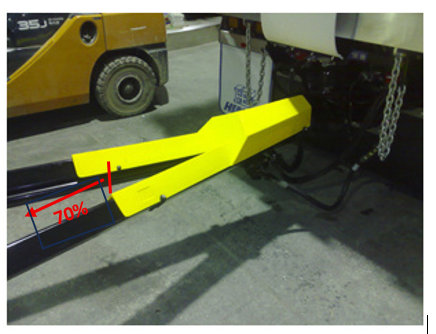
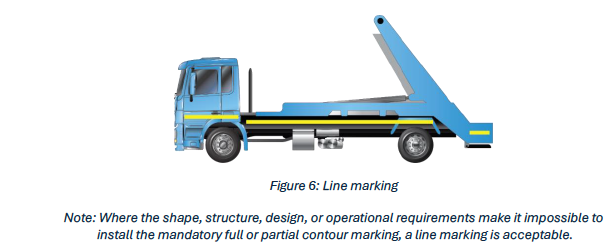
Conspicuity markings on drawbar: Fitment of conspicuity markings must follow guidance outlined in the Australian Trucking Association Technical Procedures (TAP) as follows:
- Technical Advisory Procedure – Draw Bar Trailers (note however where 70% of “ length of draw” bar is referenced to have reflective tape – it should be at least 70% of the draw bar length that is left over from the trailing edge of the draw bar cover ).
- Technical Advisory Procedure – Conspicuity Markings

-
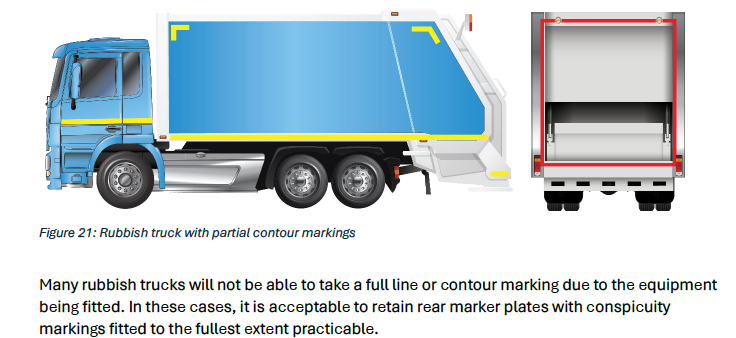
How is conspicuity markings applied to concrete agitators and other SPV’s?
Reference: ATA – Technical Advisory Procedure – Conspicuity Markings


For additional information, download the Technical Advisory Procedure here.
-
What are the vehicle requirements on trucks entering a CLOCS-A Accredited site?
For all vehicle requirement enquiries refer to the Heavy Vehicle Inspection Guide or message Paul Caus at p.caus@truck-industry-council.org.
-
What is a site?
Any location or defined area under the management or control of the principal contractor or project owner where construction activities and associated heavy vehicle movements occur. This includes any areas where these movements interface with the surrounding transport network and may pose a safety risk to workers, the surrounding community, or other road users.
Guidance Note: The CLOCS- A standard is intended to manage risks where construction logistics interact with the public. Therefore, internal movements, such as those occurring entirely within a bored tunnel, a closed rail corridor, or a fully fenced internal haul road that does not interface with the public road network, are generally excluded from the definition of a ‘Site’ for the purposes of this audit.
-
What’s the difference between pre-start inspection and pre-trip inspection?
Pre-Start Inspection
A pre-start inspection focuses on determining whether the vehicle is mechanically safe and roadworthy before the engine is started or the vehicle is moved.
Typical checks include:
- Tyres and wheels
- Lights, indicators and reflectors
- Mirrors and cameras
- Fluid levels (oil, coolant, washer fluid)
- Leaks underneath the vehicle
- Windscreen and wipers
- Couplings, turntables and safety chains
- Safety equipment (fire extinguisher, warning triangles)
- General vehicle condition and damage
The purpose is to identify defects that could make the vehicle unsafe or non-compliant before commencing work.
Pre-Trip Inspection
A pre-trip inspection is generally broader and includes the pre-start checks, but also confirms that the vehicle, load and journey are ready to commence safely.
In addition to vehicle checks, a pre-trip inspection may include:
- Load restraint compliance
- Mass and dimension compliance
- Route assessment and permits
- Fatigue management requirements
- Documentation and work diary requirements
- Trailer and load security
- Delivery instructions and site requirements
- Any journey-specific risks
The purpose is to confirm that the entire transport task can be undertaken safely and legally.
Summary
Pre-start = Is the vehicle safe to operate?
Pre-trip = Is the vehicle, load, driver and journey safe and compliant to commence?
In practice, many fleets combine both into a single checklist and simply call it a Daily Vehicle Inspection, Pre-Operational Check, or Pre-Start Check.
That distinction can become important when discussing safety technologies, load security, route risks and Chain of Responsibility obligations.



Does CLOCS‑A allow self‑accreditation?
-
A vendor says their system can “self‑accredit” operators. Is this true?
No. Vendor systems cannot grant CLOCS‑A accreditation.
They may provide tools, checklists, or internal assessments, but these have no standing in the CLOCS‑A accreditation framework unless verified by an independent CLOCS‑A Auditor.
Any claim that a system can “self‑accredit” an operator is incorrect and should not be relied upon for compliance. -
Can a vendor act as an auditor or issue CLOCS‑A accreditation?
No.
Vendors cannot:
- appoint themselves as auditors
- bypass the audit process
- issue accreditation
- claim their system “confers” CLOCS‑A status
Only approved, independent CLOCS‑A Auditors can conduct assessments and issue accreditation.
-
Can operators use self‑assessments as part of their preparation?
Yes. Self‑assessments are encouraged as a preparation tool, but they do not replace the independent audit and cannot be used to claim accreditation.
-
Does CLOCS‑A allow self‑accreditation?
No. CLOCS‑A does not recognise self‑accreditation in any form.
All CLOCS‑A accreditations must be issued through the independent audit process conducted by approved CLOCS‑A Auditors.
Internal assessments may help operators prepare, but they do not constitute accreditation.
Refer to the CLOCS-A Audit and Accreditation Business Rules and Standards: https://clocs-a.org.au/resources/audit-and-accreditation-business-rules-and-standards/ -
How can clients verify whether an operator is genuinely accredited?
Clients should request:
- the operator’s CLOCS‑A accreditation certificate, and
- confirmation via the CLOCS‑A accreditation register.
If in doubt, clients can contact CLOCS‑A directly for verification.
-
What are the risks of relying on vendor “self‑accreditation” claims?
Relying on vendor claims exposes organisations to:
- False assurance — believing an operator is accredited when they are not
- Contractual non‑compliance — non‑accredited operators entering site
- Reputational damage — appearing to dilute a national safety standard
- Legal exposure — especially after a safety incident
- Supply chain inconsistency — different vendors claiming different “accreditation” pathways
Independent auditing eliminates these risks.
-
What does CLOCS‑A consider a valid accreditation
A valid CLOCS‑A accreditation is one that:
- has been assessed by an independent, approved CLOCS‑A Auditor,
- meets all requirements of the CLOCS‑A Standard, and
- is recorded in the official CLOCS‑A accreditation register.
No other pathway is recognised.
-
What is the role of vendor systems in the CLOCS‑A process?
Vendor systems can:
- help operators collect evidence
- support internal readiness checks
- streamline documentation
Vendor systems cannot:
- determine compliance
- replace the independent audit
- issue accreditation
They are support tools, not accreditation pathways.
-
What should I do if I encounter a vendor making misleading accreditation claims?
You can notify CLOCS‑A confidentially. We will clarify the requirements with the vendor and ensure consistent messaging across all.
-
Why does CLOCS‑A require independent audits?
Independent audits ensure
- Credibility — assessments are impartial and free from conflicts of interest
- Consistency — the standard is applied uniformly across all operators
- Defensibility — accreditation can withstand scrutiny after incidents
- Public confidence — essential for a national safety standard
These protections cannot be achieved through self‑assessment or vendor‑driven processes.
How to become a CLOCS-A Auditor
-
How do I apply to become an auditor?
To become a CLOCS-A Auditor, please:
- Read the Auditor Application Handy Hints document
- Read the CLOCS-A Auditor Code of Professional Ethics, Terms and Conditions
- Enrol in the official CLOCS-A Auditor Training course
- Familiarise with the CLOCS-A Standard related documents
- Once qualified, register as an auditor through CLOCS-A.
Learn more here.
-
How do I maintain my auditor status?
You’ll need to demonstrate ongoing competency—through periodic participation in refresher training and staying updated on guideline revisions.
-
Is ongoing training or professional development required?
Auditors are expected to stay current with updates to the CLOCS-A Standard, inspection guides, and best practices in vehicle and driver safety. (Implied from training requirements.)
-
What does the auditor role involve?
Approved CLOCS-A Auditors must adhere to the CLOCS-A Auditor code of conduct, which outlines the principles and standards of behaviour expected of CLOCS-A approved auditors.
Certification for CLOCS-A Auditors
Auditors to the CLOCS-A Standard must be certified by CLOCS-A Managing Body. The requirements for becoming a certified CLOCS-A Auditor are outlined in the CLOCS-A Auditor Certification Procedure.
Auditor review/ feedback/ complaints management
CLOCS-A Auditors will need to be prequalified / approved by CLOCS-A Managing Body and registered as an approved CLOCS-A auditor.
Certification for CLOCS-A Auditors
The CLOCS-A Managing will review auditor performance periodically. Auditors may be removed from the approved panel if there is a breach of the code of conduct, or performance is deemed unsatisfactory, for example from repeated complaints, or serious/ repeated incidents or non-conformances by CLOCS-A accredited company.
Auditors work within a network of experts to verify organisations’ compliance with the CLOCS-A Standard and support excellence in safety and community outcomes.
-
What qualifications or training are required?
The route to becoming a CLOCS-A Auditor is detailed in the Auditor Application Handy Hints document (refer to Table A, items 1 or 2 – 5):
- For Existing Auditors
- Existing auditor qualifications
- A level of Heavy Vehicle knowledge
- For New Auditors
- Completion of relevant competency units (available through TAFE and RTO providers)
- For Lead Auditors
- Automatically recognised if certified with TruckSafe or NHVAS
- Exemptions
- NHVAS/TruckSafe Auditors are exempt from completing the HVIA Truck Recognition Short Course
- For Non-transport Qualified Auditors
- Must complete the HVIA Truck 101 Short Course
- Insurance Requirements
- Hold valid Professional Indemnity and Public Liability Insurance
- Mandatory Requirements for All Applicants:
- Possess a Construction Safety White Card (CPCWHS1001 – Prepare to Work Safely in the Construction Industry)
- Successfully pass the CLOCS-A Auditor Exam to be officially recognised as an Accredited CLOCS-A Auditor
- For Existing Auditors
-
Who can become a CLOCS-A auditor?
The route to becoming a CLOCS-A Auditor is outlined in Table A of the Auditor Application Handy Hints document. For an existing auditor applying to become a CLOCS-A auditor they will need to have:
- Existing auditor qualifications
- A level of Heavy Vehicle knowledge,
- A construction safety white card, and to
- Pass the CLOCS-A auditor exam.
A new auditor will need to undertake a set of competency units, which are available through many TAFE and RTO providers. They will have completed applicable elements, numbered 1 or 2, to 5, in Table A.
Lead auditor qualifications will be recognised and are recognised by default if the applicant is Trucksafe and/or NHVAS certified. NHVAS and Trucksafe auditors are also exempt from undertaking the HVIA truck recognition short course.
Existing non transport qualified auditors will need to undertake the HVIA Truck 101 short course.
All potential auditors will hold a Construction Safety White Card (Prepare to Work Safely in the Construction Industry) ‘CPCWHS1001’.
All CLOCS-A auditor applicants must undertake the CLOCS-A auditor exam.
Auditors will also hold an appropriate level of Professional Indemnity and public liability insurance.
Upon passing the CLOCS-A auditor exam you can be recognised as a CLOCS-A auditor after the initial annual auditor registration fee that will then be invoiced.
Download the Auditor Application Handy Hints document.
How to become a CLOCS-A Accredited Organisation
-
Are there different levels of Accreditation?
Yes, for infrastructure projects that fall under the CLOCS-A standard, there will have various requirements to meet in terms of the heavy vehicles, drivers, logistics planning and communications. There will not be just a single list of requirements for participation in the standard – but three different levels of requirements:
- Bronze
- Silver
- Gold
To begin CLOCS-A accreditation, construction projects must assess their risk exposure to vulnerable road users (VRUs). The CLOCS-A Standard identifies key risk factors, and the Project Rating Tool categorises projects as Bronze, Silver, or Gold based on their interaction with heavy vehicles. While there is no mandatory rating, completing the tool is essential for understanding VRU exposure and determining the appropriate accreditation level. Silver-rated projects must meet at least Silver accreditation, while Bronze-rated projects can apply for any level.
Learn more.
-
Are there different types of CLOCS-A Accreditation?
Yes, CLOCS-A offers different accreditation types, including:
- Construction Accreditation: For construction developers and principal contractors. Learn more.
- Transport Accreditation: For commercial vehicles weighing over 4.5 tonnes, including abnormal indivisible loads and engineering plants. In some cases, vehicles under 4.5 tonnes may also be subject to the Standard, depending on specific client contract requirements. Learn more.
- Combined Accreditation: For construction companies that manage both site operations and their own transportation fleets. Learn more.
-
How can I maintain my CLOCS-A Accreditation?
Accreditation to the CLOCS-A Standard is renewed through passing the biennial self-assessment or a CLOCS-A reaccreditation audit every other year. Unannounced visits may take place without prior notice after accreditation is granted.
To maintain accreditation, organisations must:
- Ensure ongoing compliance with CLOCS-A standards.
- Update any changes in company or fleet details as required. A new audit may be required.
-
How can I upgrade my CLOCS-A Accreditation
Accreditation to the CLOCS-A Standard is awarded based on the compliance achieved against bronze, silver, and gold set criteria requirements.
Progression to Silver and Gold Accreditation will only be achieved by the organisation providing the required minimum level of evidence to demonstrate they comply with the requirement.
As such, an organisation cannot achieve Silver- level accreditation, unless it can demonstrate that the Silver requirements in the CLOCS-A Standard have been met. Likewise, an organisation cannot achieve Gold-level accreditation, unless it can demonstrate that the Gold requirements in the CLOCS-A Standard have been met.
For Transport Operators, the organisation can have a mixed fleet of Bronze, Silver, Gold – level vehicles, but their organisation’s overall accreditation will be granted based on the level of which the majority of vehicles comply with.
Similarly, a construction contractor can have projects / sites operating at bronze, silver and gold- level requirements, but the organisation will only be granted the level at which the majority of projects/ sites comply with.
If the mix of vehicles or projects / sites are even, the accreditation awarded to the organisation will be the lowest of the two.
-
How long is the CLOCS-A Accreditation valid?
Accreditation to CLOCS-A is granted from the date listed on the CLOCS-A Accreditation certificate and remains valid for a period of 24 months. An online review is conducted 12 months following accreditation.
-
Is the Vulnerable Road User (VRU) Training course mandatory to obtain CLOCS-A Accreditation?
Yes. As part of the CLOCS-A Standard, specific training and competency criteria are established for drivers of heavy construction vehicles. These requirements must be met by the organisation and project they are associated with in order to obtain accreditation to the CLOCS-A Standard. It includes training standards for drivers, with a focus on “Vulnerable Road User Awareness” for accreditation.
The VRU training program consists of three levels:
- Bronze
- Silver, and
- Gold.
Advancing to the VRU Silver level requires completion of the VRU Bronze training, which serves as a prerequisite for the VRU Gold level.
Training can be held in two ways:
- In-house facilitation using handouts/ PowerPoint-style through a registered training provider, or
- Via eLearning-style module. Learn more here.
-
What are the Accreditation fees?
CLOCS-A has developed a schedule of rates outlining the indicative cost of an accreditation audit. Audit fees shall be capped to this schedule and will be reviewed annually.
Indicative audit fees have been calculated based on current industry standards for audits taking into consideration the audit type, time involved in review of documentation, and conducting site verification activities.
Review CLOCS-A Accreditation fees here.
-
What are the benefits of obtaining CLOCS-A Accreditation?
Benefits include:
- Zero road trauma between construction vehicles and the community
- Increased productivity and efficiency
- Fewer vehicle journeys
- Improved air quality and reduced emissions
- Reduced reputational risk
- Position competitively in government contract bids aligning with CLOCS-A standards
- Connect with industry professionals to explore business opportunities and build relationships within the sector
- Enable continuous improvement and innovation for your staff in construction logistics practices
-
What are the steps to achieve CLOCS-A Accreditation?
The accreditation process involves:
- Submitting an application with company and fleet details.
- Undergoing an external verification audit.
- Implementing safety standards as per CLOCS-A guidelines.
Overview of the CLOCS-A Accreditation Process:

For more information, review the Audit and Accreditation Business Rules and Standards document.
-
What is CLOCS-A Accreditation?
Construction Logistics and Community Safety – Australia (“CLOCS-A”) is a national voluntary Standard developed with the primary aim of managing the risks and impacts associated with a construction project’s on-road transport and logistics activities to improve community road safety.
CLOCS-A Accreditation demonstrates an organisation’s commitment to safety, accountability, and community awareness by adopting a national, standardised framework that helps construction organisations and transport operators manage risks associated with construction vehicle activity, protect vulnerable road users (VRUs), and improve road safety standards.
Learn more.
-
What resources are available to assist with the accreditation process?
CLOCS-A provides various resources to support organisations to initiate with accreditation, such as:
- CLOCS-A Accreditation Application Training Course: Organisations Seeking CLOCS-A Accreditation.
- Handy Hints documents for the tree types of Accreditations, Construction, Transport and Combined.
Review resources here.
Other resources to support organisations during the audit include:
- Self-assessment Checklists for the tree types of Accreditations, Construction, Transport and Combined.
- Standard Related documents.
- Project Rating Tool.
- Driver Safety.
- Vehicle Safety.
- Human Impact Route Assessment.
- Vulnerable Road User Training.
-
Who can apply for CLOCS-A Accreditation?
Organisations involved in construction logistics, including transport operators and construction companies, can apply for CLOCS-A Accreditation to showcase their adherence to safety standards.
CLOCS-A is applicable to various development projects that have a significant impact on the community, including:
- Large-scale infrastructure developments with prolonged construction timelines
- Projects in areas where construction traffic movements need to be carefully managed (e.g., busy residential neighborhoods)
- Developments located in areas with a high volume of vulnerable road users or a strong presence of cycling and walking activities
- Projects near intersections where accidents involving construction vehicles and vulnerable road users have been reported
- Any development or planned road maintenance that involves frequent movements of construction traffic.

How to become a CLOCS-A Member
-
Are there different types of CLOCS-A memberships?
Yes, there are different types of CLOCS-A memberships, tailored to suit various sectors involved in construction logistics and safety. The main membership categories include:
- Government Membership – For local, state, and territory authorities involved in infrastructure, transport, or safety policy.
- Construction/Developers Membership – For principal contractors, builders, and developers aiming to embed safety into project logistics.
- Transport Operator Membership – For operators of specialist vehicles servicing construction sites.
- Support Services Membership – For organisations offering logistics support, safety equipment, training, or vehicle technologies.
Each membership type may include different tiers with varying benefits, such as public recognition, access to training, and participation in the CLOCS-A Working Group.
-
How can I renew my CLOCS-A Membership?
Follow the next steps to renew your membership:
- Go to www.clocs-a.org.au and click “Register Here” at the top corner of the homepage.
- Under “Already a member?”, click the “Login Membership” button.
- Enter your registered email address and password.
- If you’ve forgotten your password, click “Forgot Password” and follow the prompts to reset it.
- Once logged in, click “My Memberships.”
- Select “Renew” to proceed with the membership renewal.
- Follow the prompts to complete checkout.
Contact us at admin@clocs-a.org.au if you have any questions.
-
How can members contribute to CLOCS‑A’s strategic direction?
Members can join the CLOCS-A Working Groups, participate in consultations, and share insights at industry events.
-
How do I apply to CLOCS-A Corporate Membership?
Complete the online membership application form and proceed to checkout upon submission.
-
What benefits does the CLOCS-A membership include?
Members benefit from:
- Public recognition for their commitment to community safety
- A voice in shaping industry standards for a safer community
- Exclusive networking and collaboration opportunities
- Media exposure and promotional opportunities
- Access to specialised training for staff
- Expert guidance and support in implementing the CLOCS-A standard
To explore the specific benefits available to your organisation, click “Apply Here” under your relevant category:
-
What is the cost and membership period?
Fees vary by membership type and tier—typically annual, payable upon sign-up or renewal.
Explore the memberships fees by group:
-
Who is eligible for CLOCS-A Corporate Membership?
Regulators, construction organisations, transport operators, and support service providers are all eligible to join, with tailored membership options available for each group.
Membership provides access to the CLOCS-A community network and resources, however, does not result in accreditation.
CLOCS-A Corporate Memberships are categorised into four specific groups:
- Government: State, territory, and local government bodies focused on road safety and construction oversight.
- Construction/Developers: Construction firms and developers looking to embed logistics safety into project delivery.
- Transport Operators: Operators responsible for specialist vehicles in construction logistics, including heavy and oversize transport.
- Support Services: Organisations offering logistics services, safety training, vehicle tech, and support aligned with the CLOCS‑A Standard.
Together, these four groups form a strong network dedicated to the safety of the community in the construction logistics industry.
How to become a CLOCS-A Supply Page Partner
-
Can I upgrade or downgrade my tier later?
Yes—partners can modify their tier status based on changing needs or strategic direction.
- Go to www.clocs-a.org.au and click “Register Here” at the top corner of the homepage.
- Under “Already a member?”, click the “Login Supply Page Partner” button.
- Enter your registered email address and password.
- If you’ve forgotten your password, click “Forgot Password” and follow the prompts to reset it.
- Once logged in, click “My Memberships.”
- Remove your current subscription from the cart.
- Browse available Supply Page Partner Subscription Tiers.
- Add your new preferred tier to the cart and proceed with payment.
Contact us at admin@clocs-a.org.au if you have any questions.
-
How can I renew my Supply Page Partner Subscription?
To renew your subscription, follow the next steps:
- Go to www.clocs-a.org.au and click “Register Here” at the top corner of the homepage.
- Under “Already a member?”, click the “Login Supply Page Partner” button.
- Enter your registered email address and password.
- If you’ve forgotten your password, click “Forgot Password” and follow the prompts to reset it.
- Once logged in, click “My Memberships.”
- Select “Renew” to proceed with the subscription renewal.
- Follow the prompts to complete checkout.
To Upgrade or Downgrade Your Subscription
- Remove your current subscription from the cart.
- Browse available Supply Page Partner Subscription Tiers.
- Add your new preferred tier to the cart and proceed with payment.
Contact us at admin@clocs-a.org.au if you have any questions.
-
How do I register as a Supply Page Partner?
Register for one of the three Supply Page Partner tiers here:
- Click the Apply button for your desired Supply Page Partner level.
- Fill out the Supply Page Partner application form.
- After submitting the form, you will be redirected to the checkout page for payment. If not, check your inbox for an email with further instructions.
- Select your preferred payment option and complete the transaction.
- Your Supply Page Partner subscription will be confirmed once the payment is processed.
-
How long does the Supply Page Partner subscription last and what is the cost?
The Supply Page Partner subscription is typically renewed annually.
Renewal timing and fees depend on your chosen tier.
Pricing is based on your selected partnership tier. The available tiers are:
- Supply Page Partner 1
- Supply Page Partner 2
- Supply Page Partner 3
Each tier offers varying levels of visibility and benefits. Download the CLOCS-A Supply Page Partner Advertisement Pack here.
-
Is there a cost to join the Supply Partner program?
-
What are the benefits of partnering with CLOCS-A?
Being a Supply Page Partner offers CLOCS-A members the chance to engage with our supply partners and like-minded individuals in our local and global network.
This connection provides business opportunities related to the services and products you promote.
It also allows for dialogue exchange on continuous improvement processes and offers professional development opportunities as industry collaborators.
- Join a member community in the Construction and Logistics sector dedicated to prioritising the safety of its employees and the wider community.
- Increase awareness within the industry and across different government levels about your commitment to and endorsement of the CLOCS-A standard.
- Assist in the development of your employees through Continuous Professional Development.
- Expand your business networks and client base.
- Help keep your organisation at the forefront of Safety within the industry.
-
What types of products or services qualify?
Suppliers offering equipment and technologies that improve heavy vehicle safety—such as blind-spot monitoring, underrun protection, and audible warnings—as well as logistics management solutions and training services that enhance safe logistics practices and heavy vehicle operations.
Interested suppliers may refer to the CLOCS-A Standard for more information on the requirements for organisations.
-
Who can become a CLOCS-A Supplier?
Organisations that provide vehicle safety technology and equipment, safety-focused training services, or logistics-related safety supplies aligned with the CLOCS-A Standard are eligible to become CLOCS-A Supply Partners.
Privacy and Terms
-
CLOCS-A Privacy Policy and Terms and Conditions
Useful Links
-
Australia’s Biggest Public Transport Project | Sydney Metro
-
Bureau of Infrastructure and Transport Research Economics (BITRE)
-
CLOCS – Construction Logistics and Community Safety
-
Commonwealth Office of Road Safety
-
Construction Trucks and Community Safety : VicRoads
-
FORS Homepage – FORS – Fleet Operator Recognition Scheme (fors-online.org.uk)
-
Metro Tunnel
-
NHVR Heavy Vehicle Safety Initiative (HVSI)
-
NSW Centre for Road Safety
-
Safe Load Program
-
Victoria’s Big Build